ELIAS ART
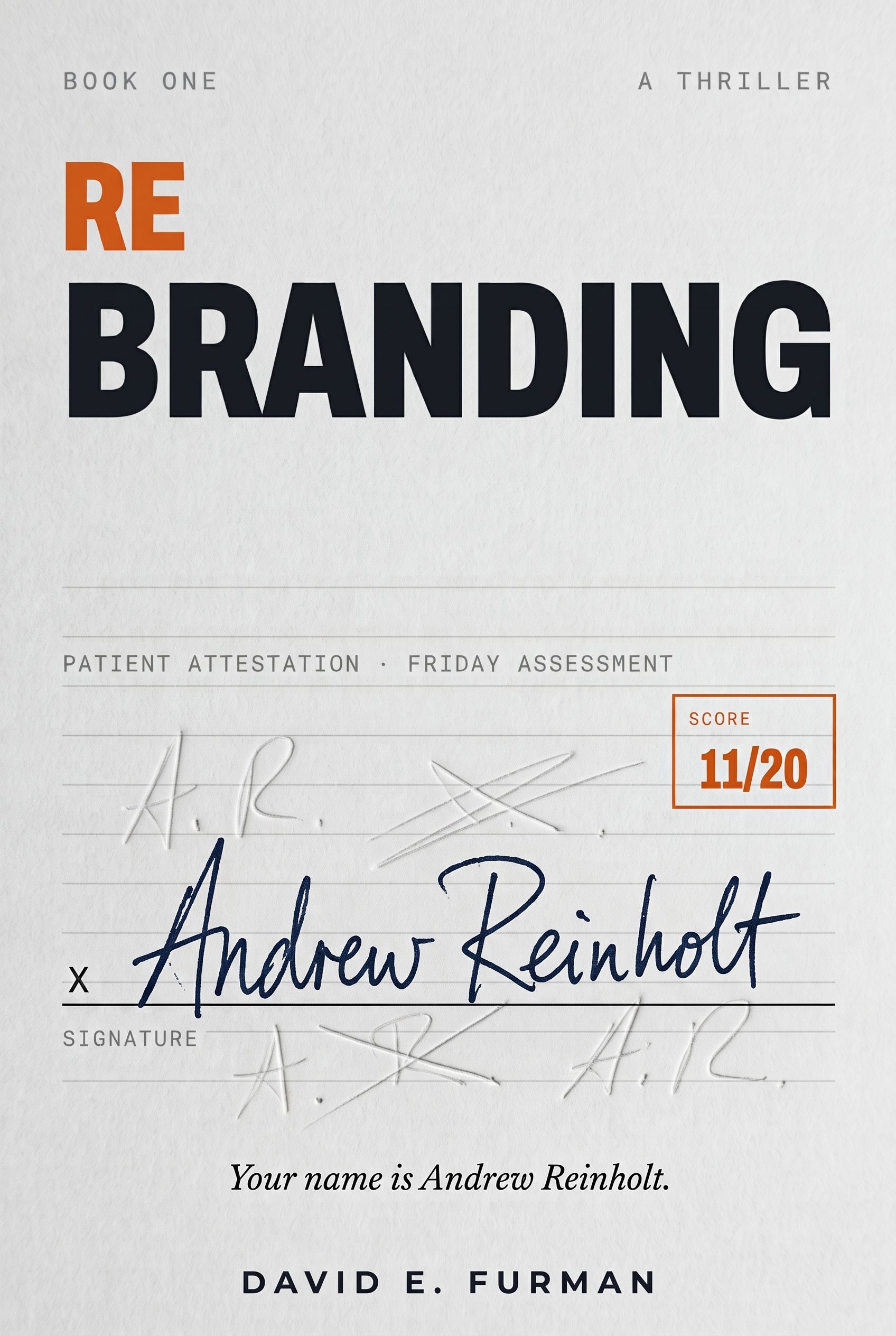
The cover of Rebranding by David E. Furman: a form headed Patient Attestation, signed Andrew Reinholt, with a score of 11 out of 20

A Rebranding novel · Book one · Out now

RE
BRANDING

Your name is Andrew Reinholt.

Andrew Reinholt built one of the largest companies in the world from nothing. His heart is failing, his own labs are growing him a new one, and he has planned for every way the surgery could go wrong. Then he wakes up, and he doesn’t remember any of it.

The story

A man grading his own exam

Seattle, 2057. Andrew Reinholt is fifty-eight, the founder of ANDR Corp., a company with a hand in nearly every market. He came from nothing, he has no family, and he looks as if he has never been ill in his life. Then a routine scan finds his heart failing, and his own medical company, Kos Industries, starts growing him a new one from his cells.

He prepares for the surgery the way he prepares for everything. His founder shares go into a trust, and his chief of staff, Jessica Strasser, holds the proxy. A procedure like his can leave a patient with amnesia, so his authority will come back only when he passes a test he has written himself: twenty questions, every Friday, answered a specific way. One director calls it a man grading his own exam.

A week after the operation he wakes in the private hospital he built beneath his own house. He remembers nothing but a long bridge with no railing, and the wind. His doctor, Margot Dufour, has to tell him his name. She keeps coming back to something he asked of her before the surgery: if he has lucid spells and forgets them afterward, she is not to press him about them. In ten years he had never once asked her not to verify something.

Everything he reads about himself sounds like someone else’s life. The company’s receptionist can list his acquisitions alphabetically, but she can’t tell him where he grew up. And the science in his company’s files comes easily, faster than it should. He decides to take that as a good sign.

An excerpt · From chapter three

He wakes up

The next morning, Margot and Sara were both beside the bed when the wake timer ran out, and the house began to bring him out of the coma: the cooling blanket warmed, and the ventilator let him take over his own breathing a little at a time. Margot watched the wall as his heart rate climbed along with his core temperature. The ventilator was down to minimal pressure support.

“His eyes just fluttered,” Sara said. “I think he’s waking up.”

Margot looked from the wall to the man in the bed, and sat him up to forty-five degrees.

“He’s breathing on his own,” Margot said. “The tubes come out as soon as he can follow a command.”

Sara took a pair of gloves from the cabinet and pulled them on, and Margot went around to the other side of the bed. His eyes opened and blinked against the light.

“Andrew, squeeze my hand,” Margot said. After a moment his fingers closed on hers.

Sara moved to his head and carefully removed the tape around his mouth. She let down the cuff and drew the tube out in one smooth pull while he coughed. She did the same with the smaller gastric tube, which was threaded through his nose. It was over in a few seconds.

Margot reached out to touch his shoulder. “Welcome back.”

He turned his head toward her voice, slowly. His eyes took several seconds to focus; she watched them wander, slide past her, and come back, until at last they found her face and held there. She smiled at him. There was no recognition in the look he gave her, only a kind of wonder, as if a smile were a thing he hadn’t seen in a very long time. Andrew tried to reply. His lips moved, but no sound came.

“Give it a few minutes,” Sara said from his other side. “Your voice will come back.” He turned toward her just as slowly, and gave her the same long look. Her voice was calm, and Margot could hear the excitement under it.

Andrew tried again. This time the words came, soft and hoarse. “What’s going on?”

“You’re just coming out of recovery,” Margot said. She moved around the bed to stand next to Sara, so that he wouldn’t have to keep turning his head.

He looked confused. “Did I fall?”

Margot and Sara exchanged a glance. “No,” Margot said. “The surgery was for your heart. Everything is fine now.”

Andrew still looked confused. “I remember walking across a long bridge without railing to hold on to. The wind…” Then the coughing took him.

Sara put an arm behind his head to hold him steady and held a tissue to his mouth with her other hand, while Margot crossed the room to the cabinets and sink on the opposite wall. “You’re okay. Just go slow,” Sara told him. “Your throat’s going to be sore for a couple of days.”

When the coughing stopped, he fell back against the pillow, rasping. Margot came back with a glass of water and a straw. He reached for the glass, and she kept her hand under it and guided the straw for him. He took a few sips, and his shoulders came down.

Andrew looked up at Margot. “Can you tell me who and where I am?” It was barely a whisper. “The only thing I remember is that bridge.” He stopped there, but his eyes stayed on her, wide open.

Margot set the glass down on the bedside table and pulled up a chair. “Your name is Andrew Reinholt.”
The setting

The world of 2057

  • The house keeps the chart

    His vital signs are painted on the wall above the bed, read from implants no bigger than a grain of rice. The house noticed his illness, in his walk and then his speech, before he did.

  • Hearts grown to order

    Kos can grow a heart from a patient’s own cells in about a month, and the body never fights it. But an organ raised in a tank has never had to work for a living. After six years or so it starts to come apart.

  • The surgeon is software

    Dr. Sebastian Zane was built by Kos to be the perfect doctor, down to the wrinkles around his eyes. He is the face of Physician as a Service, waiting on final FDA approval.

  • A human doctor is a luxury

    Once a machine cost less than the person it replaced, good doctors went to work for the very rich, who pay well to put a human face on their private medicine.

  • Surgery leaves no mark

    Cold plasma bio-welding closes a wound so well that within a couple of hours the skin forgets it. Margot runs her palm across his chest and can’t find the operation anywhere.

  • Five floors down

    His house on the Sound is real wood, all of it. When he needed more room, tunneling machines bored five levels into the hillside below it. The second one down is his own hospital.

What it asks

The questions

  1. If you can’t remember your life, is it still yours?

    He feels like a ghost watching another man’s life through his eyes.

  2. Who do you believe when everyone knows you better than you do?

    Margot holds machines to the rule she holds people to: trust but verify.

  3. Can a man write the test that proves he is himself?

    Every Friday, twenty questions that only their author can answer.

From the author

“I’ve thought a lot about what makes a person a person and not somebody else, and what happens when the continuity of memory breaks. I outlined the series about eleven years ago.”

David E. Furman

The series

  1. RebrandingBook one · Out now
  2. RecoveryBook two · Coming soon
  3. ResurgenceBook three · Planned
  4. ReconciliationBook four · Planned

Out now

Your name is Andrew Reinholt.

Rebranding is a grounded speculative thriller, and the first book in a four-part series by David E. Furman. It’s for readers who like near-future stories that stay close to real science, mysteries told from inside one man’s head, and the question of what makes someone who they are.

You’ll get an email when the next Rebranding book is out, and now and then news of new work. Unsubscribe any time. Privacy

Genre
Grounded speculative thriller
Setting
Seattle and Puget Sound, 2057
Length
About 87,000 words
Paperback
266 pages, 6 × 9 in
Series
Book one of four
Published
October 23, 2026
Kindle
$2.99 on Amazon
Paperback
$11.99 on Amazon
Paperback ISBN
979-8-16420-966-7